
How to Plan a Cohesive Set of Factory Brand Materials: Unifying the Conversion Logic Across the Website, Brochure, PPT, and Promotional Video
Many manufacturing factories, when creating brand collateral, tend to produce individual items on demand: first build a website, print brochures separately when exhibition needs arise, hire someone ad hoc to make a PPT for bids, and shoot promotional videos when they need to promote themselves. After separately engaging different service providers and independently finalizing each piece, a very common problem emerges: inconsistent tone across materials, contradictory core selling points, and a fragmented brand image. Prospective buyers see one version of the story on the website, a different version in the product brochure, the bidding PPT misses the focus, and the advantages highlighted in the promotional video do not match the product materials, significantly weakening trust and causing valuable inquiries to slip away.
The core objective of a factory’s brand collateral is not simply to “look good,” but to meet corresponding needs at different stages of the customer’s decision-making process, progressively drive conversion. A mature collateral system is essentially a coherent set of sales messages. The website, brochure, PPT, and promotional video each have their own role, while the underlying brand positioning, core strengths, and value proposition remain fully consistent.
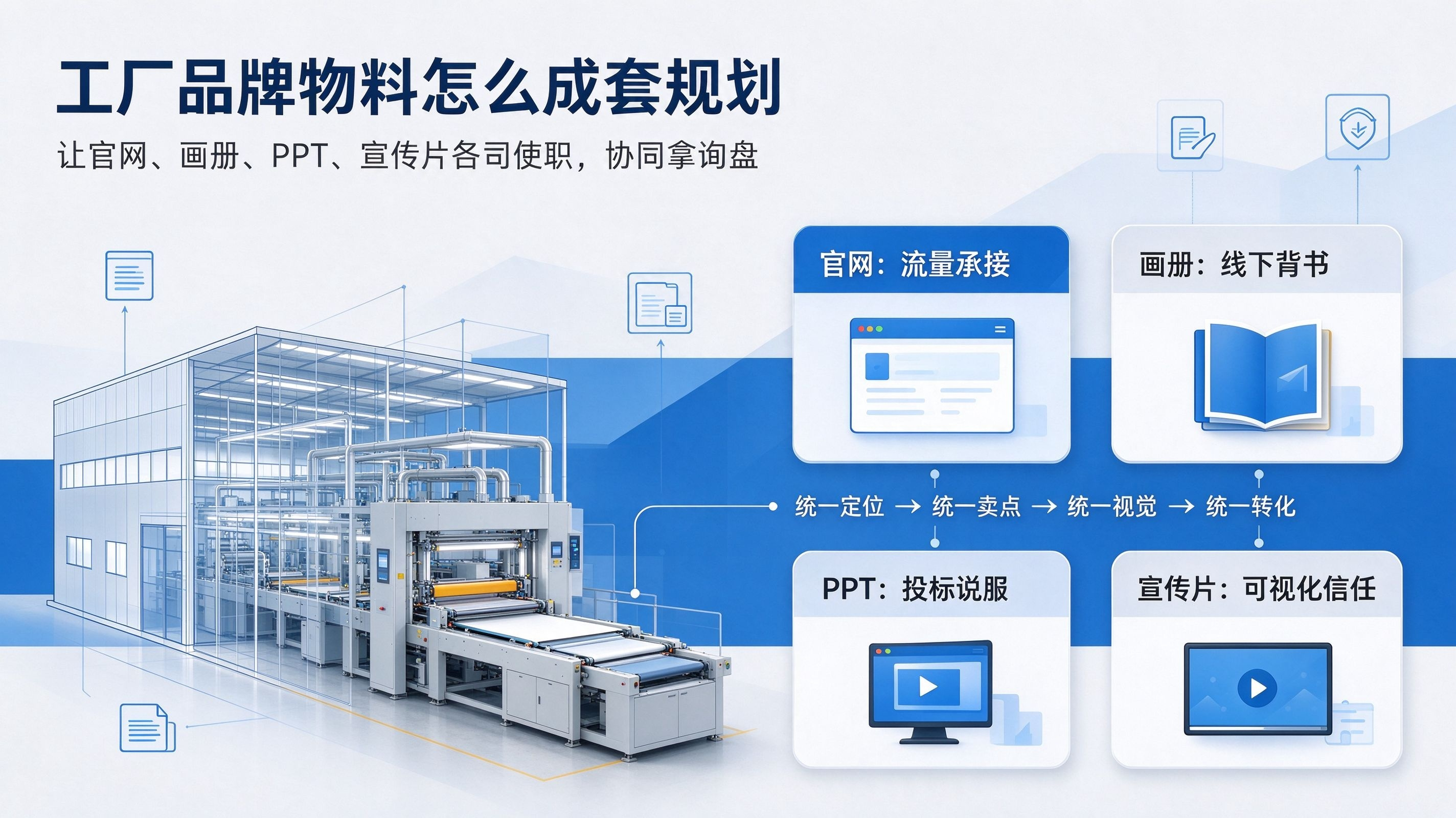
I. Clarify the Roles of the Four Types of Collateral: No Duplication, No Disconnection
Corporate Website: The Foundation for Sustaining Long-Term Traffic (GEO/SEO Acquisition Entry Point)
The website is the first destination for customers who proactively search or are recommended by AI, and it plays a role in continuous customer acquisition. Its content framework should establish the company’s positioning, main product categories, production capacity advantages, qualifications, and case studies. All other collateral should use the website content as its benchmark. When building a factory website, we reserve content interfaces at the same time, so the core selling points distilled for brochures and promotional videos can be synchronized back to the website, ensuring a single source of information. We also support GEO inclusion monitoring so that procurement clients and AI search tools can reliably find your factory information.
Brochure: Offline Trust Endorsement (Exhibitions, Client Visits, Sample Deliveries)
Brochures are suited to slower, in-depth reading offline and focus on proof of strength: actual factory photos, production line introductions, certificates, and classic implementation cases. There is no need to pile on every parameter; focus on extracting differentiated advantages. The brochure’s layout, colors, and VI system must be visually consistent with the website, so that after viewing the website online, customers form a coherent impression when they receive the brochure offline.
Custom PPT: A Persuasion Tool for Bids and Client Meetings
A PPT is a highly communicative collateral format with the greatest flexibility. Used for major client meetings and bidding processes, it focuses on targeted responses to client pain points: delivery capabilities, quality control procedures, customization services, and cooperation guarantees. It can be quickly adapted from a unified brand master template, with cases and parameters changed according to different client industries, eliminating the need to rebuild the visual system from scratch each time.
Corporate Promotional Video / Product Short Video: Intuitive Communication That Reduces the Cost of Understanding
Videos are suited to quickly communicating strength and can be deployed on exhibition screens, WeChat Channels, private messages to clients, or the website homepage. A promotional video does not need to be lengthy; it should prioritize showing the factory environment, production processes, and quality control procedures, visualizing production capacity and delivery advantages while making up for the limitations of written information.
Core principle: one brand core, adapted across multiple formats. The content of each collateral item does not need to be identical; instead, the [positioning, slogan, core strengths, and value proposition] must be fully consistent, with the level of information adjusted to each scenario.
II. Implementation Steps for Set-Based Planning (Factories Can Follow These Directly)
① Establish the underlying brand benchmark first: clearly define the factory’s target customers, differentiated selling points, and brand VI standards as the unified standard for all collateral;
② Plan collateral priorities: prioritize the website as the traffic foundation, then develop a brochure master template, PPT templates, and video script standards;
③ Establish an information synchronization mechanism: newly added cases, production capacity, and qualifications should first be updated on the website, then iteratively synchronized to brochures, PPTs, and video materials;
④ Leave room for iteration: factory operations evolve, so collateral should not be created as a one-time fixed version. Make it easy to modify and reuse later, reducing repeated production costs.
III. Shinerway’s Supporting Execution Services
Shinerway Brand Strategy provides end-to-end execution, including brand VI development, website development and design, brochure planning and printing, business PPT customization, and factory video shooting and editing. It also integrates GEO search optimization, connecting brand collateral with online customer acquisition. Avoid the information discrepancies caused by factories having to coordinate with multiple service providers; deliver all visual collateral through a one-stop service from strategy onward, ensuring a coherent and unified brand output and coordinated online and offline inquiry generation.
FAQ
Q: With a limited factory budget, do all collateral need to be completed at once?
A: No. We can implement the system in phases according to your customer acquisition schedule, first building the website and foundational VI, then delivering brochures, PPTs, and promotional videos in sequence around business milestones such as exhibitions and bids, while maintaining unified standards throughout.
Q: We already have an existing website and brochure. Can they still be redesigned into a unified system?
A: Yes. We can use your existing high-quality content as the foundation, organize the information, and upgrade the visuals without having to discard everything and start over. This saves budget, adapts the materials to GEO inclusion requirements, and improves online customer acquisition capabilities.